


Franchise Ownership Articles > Residential Painting Franchise Opportunities: How the Business Model Works
Residential Painting Franchise Opportunities: How the Business Model Works

Quick Answer
A residential painting franchise is a locally operated service business that helps homeowners complete interior and exterior painting projects using the systems, brand, training, and resources of a franchise organization. The owner is responsible for building demand in the local market, managing estimates and customer relationships, coordinating production, and leading the business.
For the right owner, the model combines a familiar local service with an established operating framework. It is not a passive investment, and demand or financial results are never guaranteed. Success depends on market conditions, leadership, sales execution, service quality, and disciplined management.
What Does a Residential Painting Franchise Sell?
The core service is professional painting for homeowners. Depending on the local business and the services available in the market, projects may include interior rooms, full home interiors, exterior surfaces, trim, doors, cabinets, decks, fences, staining, and related preparation or repair work.
The customer is not only buying paint and labor. They are buying a managed project. That includes a clear estimate, scheduling, communication, surface preparation, production, quality checks, and cleanup. A strong residential painting business makes the process easier to understand and easier to manage for the homeowner.
This is one reason the owner’s role is larger than painting. The business must consistently turn local interest into well-scoped projects and then deliver those projects with clear communication and reliable follow-through.
Why Homeowner Demand Can Repeat Over Time
Painting is connected to the ongoing life of a home. Surfaces wear, colors age, exterior coatings face weather, families change how they use rooms, and buyers or sellers may want to update a property. Those needs can create recurring opportunities across a local market.
Demand is still affected by economic conditions, seasonality, weather, housing activity, competition, and consumer confidence. A franchise system cannot guarantee a steady volume of work. Owners must create local awareness, respond to leads, build referral relationships, and earn positive customer experiences.
The benefit of the model is not that customers appear automatically. It is that the owner can approach local demand with a defined brand, marketing resources, operating tools, and a process for moving from an inquiry to a completed project.
How a Lead Becomes a Completed Painting Project
A residential painting franchise needs a repeatable workflow. While each project is different, the customer journey generally follows four stages.
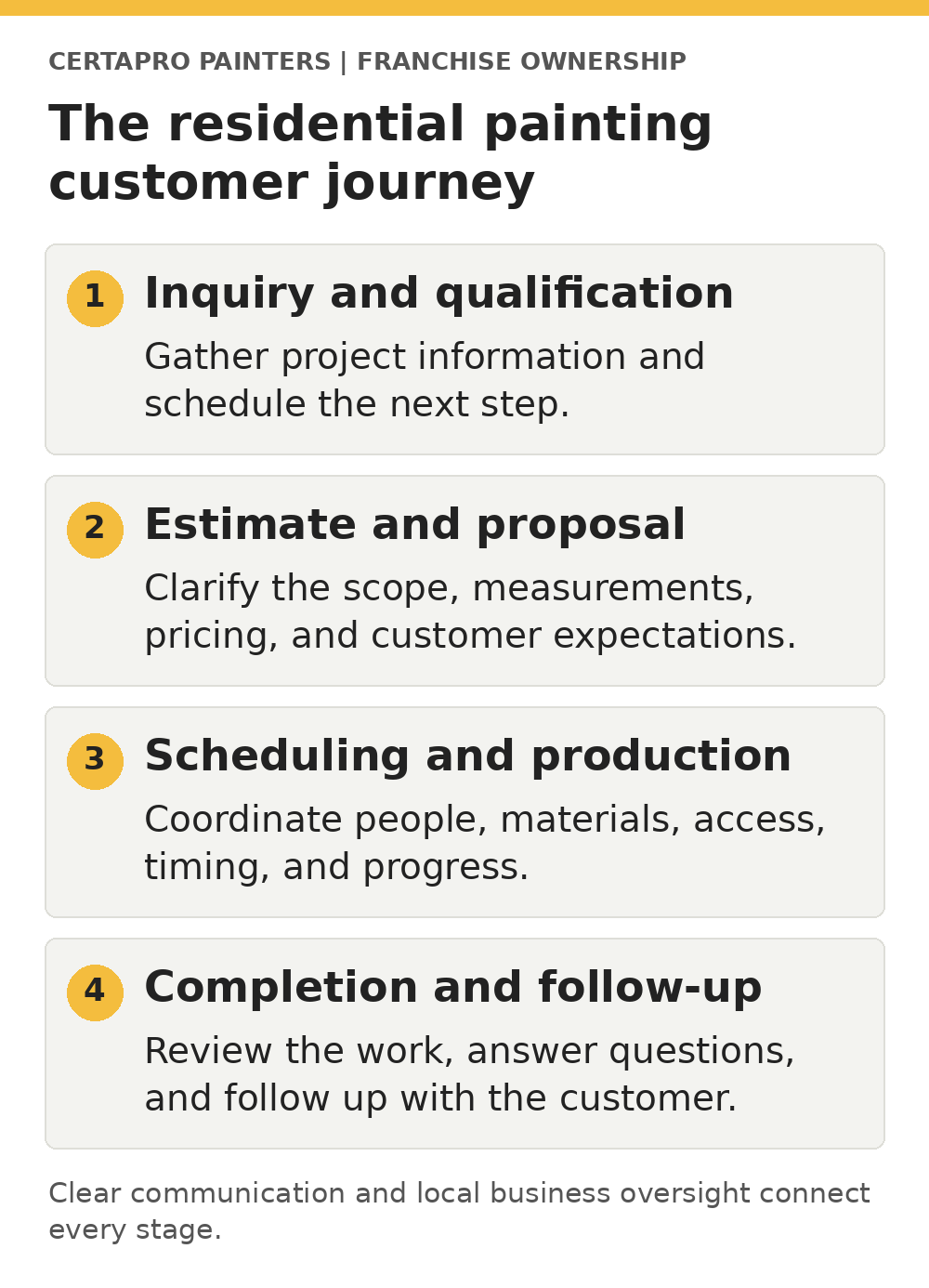
- Inquiry and qualification: A homeowner contacts the business through the website, phone, referral, or another local marketing source. The team gathers basic information and schedules the next step.
- Estimate and proposal: The project is reviewed, the scope is clarified, and the customer receives a proposal. Good estimating depends on accurate measurements, clear assumptions, appropriate pricing, and strong communication.
- Scheduling and production: The business coordinates labor, materials, access, timing, and customer expectations. The owner or production team monitors progress and addresses issues as they arise.
- Completion and follow-up: The work is reviewed, final questions are handled, and the team follows up with the customer. A well-managed closeout can support reviews, referrals, and future work.
Every stage affects the next one. Marketing without a strong sales process can waste leads. Sales without production capacity can create delays. Good production without follow-up can leave referrals and reviews on the table.
What Does the Franchise Owner Manage?
The owner is the local business leader. Some owners stay closely involved in sales and estimating. Others build a team that handles more of the daily workflow as the business grows. In either case, the owner remains accountable for the operation.
- Setting goals and reviewing performance
- Building local awareness and referral relationships
- Managing the lead and estimate process
- Recruiting and leading employees or contractors as permitted by applicable law
- Coordinating schedules, capacity, and project quality
- Monitoring cash flow, expenses, pricing, and working capital
- Addressing customer concerns and protecting the local reputation
The role is best understood as managing a professional service company, not simply performing a trade. Read The Day-to-Day of a Franchise Owner for a closer look at how those priorities can fit together.
How the Franchise System Supports the Local Business
An established franchise system can provide resources that would take time and money to create independently. For CertaPro Painters franchisees, those resources can include brand recognition, initial training, ongoing business coaching, marketing support, technology, website resources, and vendor relationships.
Training can help an owner learn the business model, understand the customer journey, and prepare to manage sales and production. Ongoing support can help owners review goals, identify gaps, and learn from people across the system. For more detail, see Training and Support.
These resources strengthen the owner’s starting point, but they do not replace local execution. The owner still needs to use the tools, manage the team, develop relationships, and make responsible decisions based on the market.
How Residential and Commercial Work Can Fit Together
A painting franchise may serve both residential and commercial customers. Residential work focuses on homeowners and their properties. Commercial work may involve offices, retail locations, multifamily properties, facilities, or other organizations.
The two customer groups can have different sales cycles, project sizes, scheduling needs, and decision-makers. Commercial work may help some owners diversify their customer base or production calendar, but it also requires the right relationships, estimating ability, insurance, staffing, and project management capacity.
Residential painting should remain the focus of a residential franchise evaluation. Commercial opportunity is one additional part of the model, not a substitute for understanding how the local homeowner business works.
Seasonality and Capacity Planning
Exterior painting is sensitive to temperature, moisture, and weather. In many markets, that creates a busier exterior season and a need to manage schedules carefully. Interior work may help balance the calendar, but customer demand still varies by location and time of year.
Owners need to plan for these changes. That can mean adjusting marketing priorities, building a pipeline before peak periods, protecting working capital, and making sure the business has enough production capacity without taking on more fixed cost than it can support.
Capacity is not only the number of painters available. It also includes estimating, administration, project coordination, and customer communication. Growth becomes harder to manage when one part of the workflow expands faster than the others.
What Should a Buyer Evaluate in a Territory?
A good market review goes beyond population. Buyers should consider the full operating picture and ask how the territory supports the business they plan to build.
- Housing characteristics: Age, condition, ownership patterns, and the mix of interior and exterior project opportunities.
- Customer profile: The size of the addressable homeowner base and how local customers select service providers.
- Geography: Drive times, density, traffic, and the practical distance between estimates and projects.
- Competition: Independent painters, other franchises, and the expectations already established in the market.
- Labor conditions: The availability and cost of qualified people to support sales, administration, and production.
- Seasonality: Weather patterns and how they may affect exterior production or cash flow.
- Local development: Housing turnover, renovation activity, and relationships that may support referral opportunities.
Territory data is useful, but it should be reviewed alongside the owner’s plan, financial resources, and ability to execute. Visit Available Markets to begin a market-specific conversation.
Is a Residential Painting Franchise a Good Fit for You?
This model may fit a buyer who wants to lead a local service business and is comfortable balancing sales, operations, people, and customer experience. Painting experience is not required, but the willingness to learn the service and follow a proven process matters.
A strong candidate is generally prepared to be visible in the market, make decisions, track performance, and work through the normal challenges of business ownership. They also understand that the brand and system create leverage only when the local owner applies them consistently.
Before moving forward, review the investment requirements, speak with the Franchise Development team, study the Franchise Disclosure Document, and talk with existing owners. Those steps provide a clearer picture than a general online description can.
Frequently Asked Questions
What is a residential painting franchise?
It is a locally owned business that provides painting services to homeowners while operating under the brand, standards, and systems of a franchise organization.
Do I need painting experience?
No. The owner’s primary role is leading and managing the business. You will need to learn how projects are estimated and delivered, but prior painting experience is not required.
Is residential painting seasonal?
Seasonality varies by market. Weather can limit exterior work during certain periods, while interior projects may support demand across more of the year. Owners still need to plan capacity and cash flow carefully.
Does the business require a storefront or large inventory?
The specific space, equipment, and inventory needs should be confirmed through the current Franchise Disclosure Document and franchise process. The model is a local service operation rather than a traditional retail store.
Can a residential painting franchise also serve commercial customers?
Yes, a painting franchise may serve commercial customers as well as homeowners, subject to the system, local capabilities, and market needs.
Explore Residential Painting Franchise Opportunities
A residential painting franchise combines a recognizable local need with the structure of an established system. The next step is to evaluate a real market, understand the owner’s role, and review the current requirements. Explore available markets and speak with the CertaPro Painters Franchise Development team.
Ready to Start Your Own Franchise?
CertaPro Painters® is here to help you create your own success story.
Get Started
